

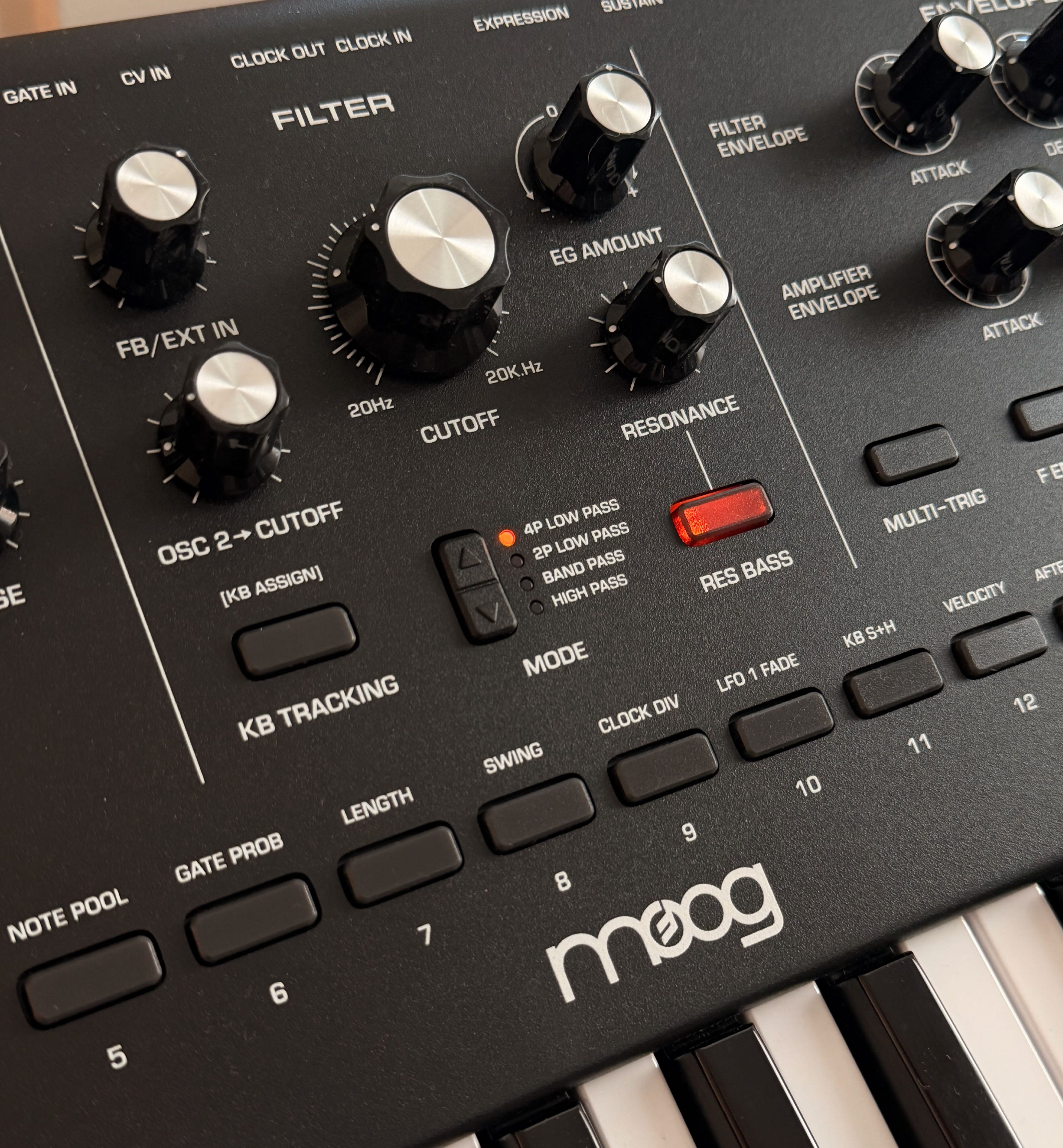
I’ve owned a few analog synthesizers over the years, but last year I finally got my first Moog.
You know Moog, even if you think you don’t. It’s the sound sitting under a startling amount of the music you already love: the warm electronic pulse on records by Stevie Wonder, Kraftwerk, Gary Numan, and New Order, the Moog that Giorgio Moroder built the entire throbbing hum of Donna Summer’s “I Feel Love” out of, even the one George Harrison hauled into Abbey Road for the Beatles. Bob Moog’s instruments quietly rewired the back half of the twentieth century, and most people never learned his name.
What gives a Moog its voice is the filter. The famous Moog ladder filter, specifically, the one people always reach for the same couple of words to describe: warm, and a little creamy. For the non-gearheads, a filter is the part that sculpts a synth's tone by taking certain frequencies away. The oscillator makes a raw, buzzing, overstuffed sound, far more than you'd ever actually want, and then the filter goes to work removing what you don't need, carving and shaping until what's left is the thing you meant to hear all along. (Moog made a free, almost defiantly analog video series about exactly this. The very first lesson is about nothing but listening, and the synth on my desk turns up in it.)
Here’s the part I love, and the part this whole letter turns on. A synth filter doesn’t add anything. It only subtracts. You arrive at the beautiful sound by deciding, carefully, what to throw out. The gearheads even call it subtractive synthesis, which is a very technical name for getting to what matters by clearing away what doesn’t.
Which is a lot of philosophy to pull out of a box of oscillators, I know. I’ve been pulling it out for a year anyway.
Years ago, before I knew the quiet pleasure of working for myself in a room I built on purpose (where, yes, the Moog now lives), I worked in an office. Around other people. And whoever held the keys to that place decided it would be fun to wire speakers down the hallway and pipe in SiriusXM’s Alt Nation from ten to six. The audio gods, who have apparently nursed a grudge against me for years, made sure one of those speakers hung directly outside my door. So every working day, while trying to edit audio, I got Passion Pit and Vampire Weekend and MGMT whether I asked for them or not.
Which meant that on top of the office politics and the bad coffee and a desk chair that funneled most of my paycheck straight to my chiropractor, I spent every day doing one more invisible job: filtering out the sound I didn’t want so I could actually hear the sound I did.
These days we’ve got little HomePods scattered around the house. Not for music (the vintage McIntosh and Marantz and Klipsch handle that, and would like a word if I implied otherwise), but for the small stuff. The weather. How many hours until the next World Cup match. And, if you’re my daughter, the fast answer to a math problem she’d rather not work out herself. The trouble with a speaker that’s always listening is that it occasionally decides to join a conversation no one invited it into. The last time my parents were visiting, my dad, not clocking that a HomePod was within earshot, said a soft “I love you, Sherri” to my mom. Siri lit right up: “Oh, thank you, I love you too!”
Apple, it turns out, has been wrestling with the same problem, just from the other side. By all appearances, at their big keynote this June they quietly altered their own audio every single time a presenter said the word “Siri,” so the broadcast wouldn’t set off a few million HomePods in living rooms around the world. Engineers who pulled up the spectrogram afterward found neat little gaps notched out right around three, four, five, and six kilohertz, exactly where that word lives, exactly when it was spoken. A dynamic notch filter, in plain terms. The same move my Moog makes, aimed at a single word. It didn’t entirely work, for the record. Plenty of people still watched their phones perk up. But I love that the most-listened-to company on earth spent real engineering effort to make its devices, for once, not listen.
Three filters, then. One I rigged out of desperation in a hallway, one Apple built on purpose for a keynote, and one that’s been sitting inside synthesizers for sixty years doing the patient work of subtraction. And all of it keeps walking me back to the same question.
What would I filter out of my own days, if I got to choose the frequencies?
Start with the obvious culprits. The phone. The scroll that quietly eats an evening. The fourth episode of something I won’t remember by morning. But the frequencies I’d really want gone are the lower, sneakier ones: the worry humming under an otherwise good afternoon, the half-attention I hand the people right in front of me while some background process churns away about email. The oscillator of an ordinary day puts out so much more than I need. Most of it isn’t even bad. It’s just there, buzzing, drowning the part I’d actually choose to hear.
I keep wondering what would be left if I got better at carving it away. What I might make, or notice, or simply enjoy, with all of that turned down.
If someone forwarded this to you and it sounds like your kind of thing, you can get the next one in your inbox, every other week.
Picked Up
If you want to practice turning the noise down, it helps to have the right record for the job. Something with enough life to keep you company and enough restraint to stay out of your way, which is a far narrower lane than it sounds. Most music misses it in one direction or the other.
My pick: SOHN, “Albadas (Dawn Songs).”
SOHN spent years making meticulous, vocal-forward electronic records, and then last fall he released something different: an entirely instrumental album he wrote in the early hours of the morning, as a daily ritual, before the day could get its hands on him. You can hear those mornings in it. The whole record has the feeling of first light, unhurried and clear, with no lyric asking for your attention and no big gesture trying to win it. I’ve had it looping through more deadlines than I’ll admit to. It does the genuinely hard thing a working record has to do, which is fill a room without ever crowding it. Put it on and notice how much easier it gets to hear yourself think.
Listen: Apple · Tidal · Spotify
And if you want to watch it breathe, there’s a live performance of “Ascent” from the album that I keep returning to. It’s worth your time.
Three more, if you’d like options:
Buddy Ross, “K We’re Here.” Frank Ocean’s longtime keyboardist made his first solo record as a gift for his newborn son, and it turns out a thing built to settle a baby works just as well on a frazzled adult at three in the afternoon.
Listen: Apple · Tidal · Spotify
Hanakiv, “Interlude.” Spare, patient piano from a London-based composer who understands exactly how much silence to leave between the notes. The space is the whole point.
Listen: Apple · Tidal · Spotify
Laura Misch, “Lithic.” Saxophone, voice, and field recordings she gathered inside actual caves and quarries, somehow assembled into the most grounding thing I’ve heard all year. Strange and warm at the same time.
Listen: Apple · Tidal · Spotify
In the Room
This issue, the room is mine, and so is the Moog.
I’ve been working on a track called “So Many.” A Moog arpeggio runs underneath the whole thing, a fast, pulsing figure that never sits still, with a simple piano melody laid over the top. The arpeggio is the engine. The piano is the thing you hold onto while the engine keeps pushing forward. It builds, it opens up, it keeps moving, and there’s a little ache under all the motion that I keep finding more interesting the longer I sit with it. It’s still a sketch, just over two minutes long, the kind of thing I make to chase a feeling before I can name it.
Here’s why it belongs in this particular letter. That pulsing Moog figure is the exact sound I described up top: an oscillator throwing off far more than anyone needs, pushed through the ladder filter until it turns warm. There is a lot happening underneath “So Many.” The piano is the one line I wanted you to actually hear, sitting calm on top of all that motion. Which, now that I’ve said it out loud, is the same thing I spend most days trying to pull off.
So many things pressing forward, all at once, all the time. The whole trick is choosing which one to keep your ears on.
(Hit play below to listen.)
Sent Out
I once heard someone who works with parents say that the single best thing you can do when your kid walks into the room is put your phone down. Not face-down on the table while you keep a hand on it. All the way down, and let it go. Because a kid reads a held phone the way a microphone reads a room. Even on mute, even with your eyes locked on them, the thing in your hand is broadcasting where your attention actually lives. A device you’re still holding is a frequency you haven’t filtered out yet.
I’m not here to wag a finger about any of this. (I’ve got a HomePod that flirts with my father and a scroll habit I’m not proud of.) But the Moog handed me a frame I can’t shake, so I’ll pass it to you for the next two weeks.
What might you need to filter out?
Just one frequency. The loudest distraction, or the quiet one humming under everything else. Carve it away for an afternoon and listen to what’s left underneath. Then hit reply and tell me what you heard. I read every one.
Chad
p.s. — One more thing about that Moog, because it’s been sitting with me since I learned it.
I always pictured Bob Moog’s synthesizers coming out of Asheville, North Carolina. Moog has been based there for decades, and still designs and builds instruments in the city, though the company changed hands a few years ago and has since moved much of its manufacturing overseas. Either way, Asheville isn’t where the story starts.
The modular Moog and the Minimoog, the instruments that put that warm, filtered sound onto all those records, were designed and built in a small village called Trumansburg, New York. A converted storefront on Main Street, a few dozen people on the payroll, in a town most of the world has never heard of.
I grew up in the Finger Lakes. Trumansburg is right there, a short drive from where I was a kid who had no idea what a synthesizer even was, let alone that the most famous one ever made was being dreamed up a couple of towns over.
It took me forty-some years and a move halfway across the country to finally bring one home. Turns out the sound I’d been chasing my entire life was built in my own backyard, the whole time, back when I wasn’t listening.