
Tape Hiss: The Volume Knob Doesn't Lie
A descent into four songs I'm not supposed to love.

First, Glen
Before anything else in this letter, I need to say something about Glen Hansard.
He died a week ago, July 29th, in a motorcycle crash on the outskirts of Dublin. He was 56. If the name doesn’t land, the song almost certainly will: “Falling Slowly,” from the film Once, which he wrote with Markéta Irglová and which won the Academy Award for Best Original Song in 2008. A movie shot for almost nothing, on handheld cameras, in a guitar shop in Dublin, beating the entire machine at its own game.
What I keep coming back to is the way he played. Glen attacked his acoustic guitar, hitting it so hard for so many years that he wore a hole clean through the top of it, and then he went right on playing that same guitar. He sang the way somebody sings who has never once considered holding back in order to seem cool about it. Watch any live clip and you’ll find a man at full volume with his eyes closed and no irony anywhere in the room protecting him. That’s a rare and difficult thing to be, and it made everyone around him braver for it.
Bono, who busked with him on Grafton Street every Christmas Eve for years, called him “voice of the streets. A choir of angels in one man.” I don’t have anything better than that.
So take some time this week. Watch Once, or put on The Swell Season, the record he made with Irglová, or crank The Frames as loud as your neighbors will tolerate. And if you want the one I keep returning to, it’s “Time Will Be the Healer,” the last track on his 2018 album Between Two Shores.
But start here, with the two of them in that guitar shop.
Rest well, Glen.
There’s a thread running from that man into the rest of this letter, and I want to name it once and then leave it alone. Glen Hansard’s whole method was a refusal to be embarrassed. No cool distance, no protective layer of irony, just a guy hollering into a room and meaning every syllable of it.
Which is a good thing to have in your ears before I confess what’s coming.
The Volume Knob Doesn’t Lie
Somewhere in the mid-nineties, a cardboard box arrived at my parents’ house in upstate New York containing twelve compact discs I had ordered for a single penny.
Columbia House. If you’re under forty, this was a mail-order club that sent you an absurd stack of music up front on the theory that you’d forget to cancel and then buy at full price forever, which most people did, and which honestly seems like a fair trade for what showed up in that box. My selections had no organizing logic whatsoever. Smashing Pumpkins next to Michael Bolton, Pearl Jam next to All-4-One, Alanis next to Mariah, alongside a whole run of Christian rock records by bands with names I can only describe as brave: Bleach, Plankeye, Johnny Q. Public, Earthsuit. (In Earthsuit’s defense, Paul Meany came out of that band and went on to build MuteMath, who are still in rotation in my house today, so the fifteen-year-old had at least one working instinct.)
What I want you to notice is what that box actually was, which is a portrait of a kid’s taste from before anybody had gotten around to telling him what taste was supposed to look like. Nothing in it was chosen to impress a single human being, because there was nobody in that house to impress. It was twelve things I wanted to hear.
Then you grow up, and you get a job in audio, and people start asking what you’re listening to.
I’ve spent thirty years around records. I run a studio. I can tell you why a mix works and where the reverb tail is sitting and what somebody did to that vocal to make it feel like it’s standing just behind you, and it also means I’m supposed to have a curated answer ready when the question comes. I do have one. It’s true, too, and it’s nowhere near the whole tape.
So here’s the whole tape. Four songs, arranged in descending order of how comfortable I am telling you about them, with a defense that gets weaker as we go.
Enjoy watching it fall apart.
One: Coldplay, “Don’t Panic.”
Barely a confession, this one. But there’s whatever Coldplay is now and then there’s Parachutes-era Coldplay, and I will happily die on the second hill, because those opening acoustic strums still stop me where I stand. To my ears, the reason this album works is Jonny Buckland, who plays almost nothing on that record and makes every note of it count. Sparse delayed electric lines way back behind the acoustic, never once reaching for a solo, leaving little ringing trails hanging in the air behind the song.
I spent entire Saturdays at Guitar Center because of that tone, plugging into every delay pedal on the wall trying to find it. To be honest, I still buy and sell delay pedals, just looking for that perfect tone.
Straight craft defense, easily made. It’s the last one that comes this cheap.
Two: NSYNC, “Pop.”
Now we’re somewhere less respectable, and I’m going to make you sit through the strongest technical argument in this entire letter, because I’ve been waiting about twenty-five years for the excuse.
By 2001, NSYNC were desperate to be taken seriously, and JC Chasez and Justin Timberlake went out and got BT to produce the lead single. Brian Transeau. The man who invented trance music and the stutter edit. Timberlake told him he could do whatever he wanted to their voices, possibly the most consequential sentence anybody said in pop that year, and what BT did with that permission was build “Pop” out of over 1,200 individual edits, running roughly forty different treatments on the vocals with processing gear that mostly lived in film sound rather than anywhere near a pop record. Then a boy band sang over the top of it, and it went to radio, and half the country filed it as bubblegum.
Go put it on good speakers and tell me it’s bubblegum. That record is a sound-design piece wearing a smile, with every gasp and consonant chopped into rhythm and a full stop dropped into the middle where the whole thing simply quits and restarts.
And now the actual confession, because the NSYNC part isn’t it.
BT has been one of my musical and sound production heroes since I was a teenager. He’s the reason I fell for EDM, which is a sentence I’ve watched land badly at more than one dinner party. And This Binary Universe, the 2006 record where he walked away from the dance floor entirely and made an ambient orchestral album built for 5.1 surround, sits on the very short list of my favorite albums ever made. Half of what I’m chasing whenever I sit down at my own keyboard is something I first heard on that record.
A few years back I got to meet him at a coworking space in Nashville. I’d like to think I played it cool…
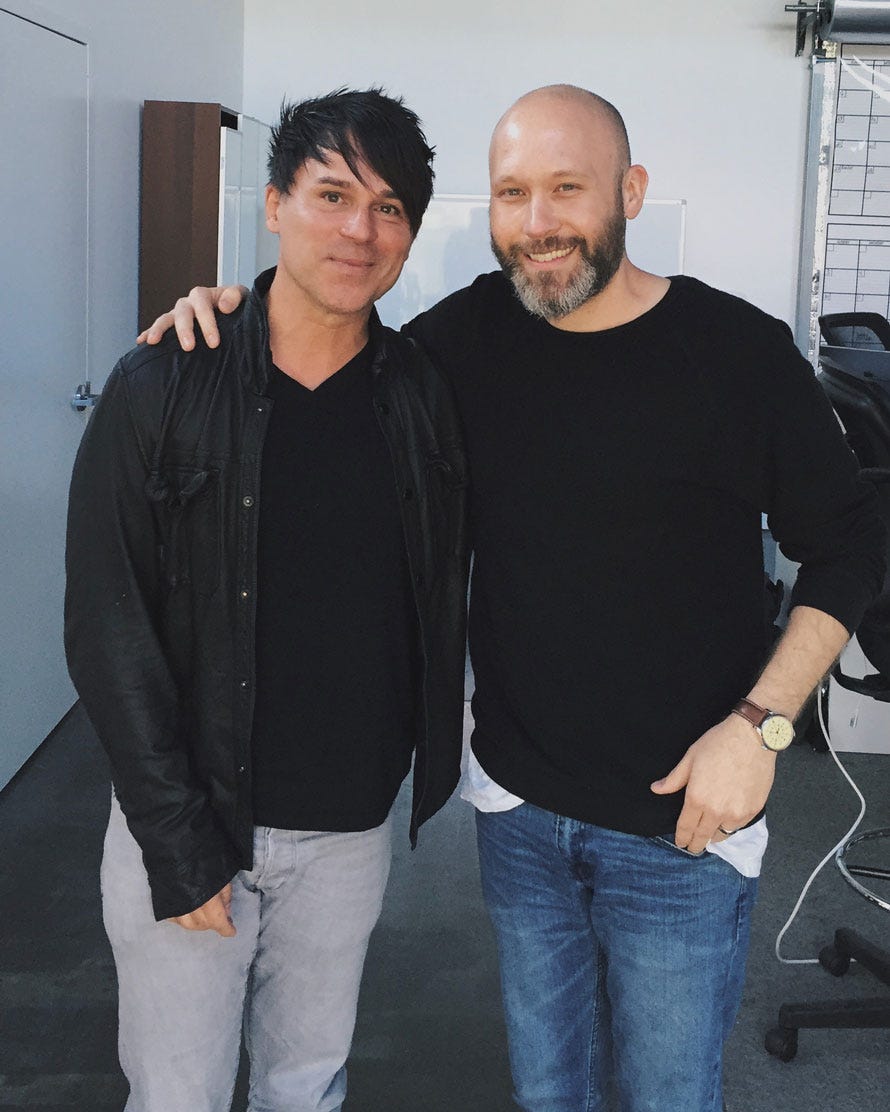
So yes, technically that rung is still a craft defense. But notice how much personal history I had to spend to get it out.
Three: Counting Crows, Across a Wire, disc one.
Here’s where the argument starts to change shape on me.
This is the 1998 double live album, and disc one is their VH1 Storytellers set recorded acoustic at Chelsea Studios, which I fell asleep to more times in college than I’m willing to put in writing. Adam Duritz singing “Mr. Jones” and “Round Here,” letting his voice crack in places where a producer would have punched in and quietly fixed it.
I could give you a technical answer about the room sound on that disc, and it would even be a good one. I’d rather tell you the truth, which is that I was nineteen and freshly wrecked by a breakup and trying to write songs about it, and that record was the only thing in the world that seemed to know what I was talking about. It didn’t make me feel better. It made me feel accompanied, which was the thing I actually needed.
Still a defense, then, if a considerably softer one. And it’s the last rung with any floor under it.
Four: Lifehouse, “Hanging by a Moment.”
Sorry, but I’ve got nothing.
Nothing structural, nothing technical, nothing about the mix. Just the summer of 2001, the one before my senior year of college, somewhere out on a road trip in a 1997 Nissan Sentra whose air conditioning had quit, which meant the windows were the entire cooling system. Me considerably angstier than my life circumstances justified, screaming this song at full volume into the wind. That car had no business playing music that loud, and it did it anyway.
There is no case to make here. The song did something to my chest that summer and my chest has never rescinded the ruling.
Except here’s the thing I found when I went looking, and it’s quite interesting.
“Hanging by a Moment” never reached number one on the Billboard Hot 100. Peaked at two. But it hung around the chart so long and got played so relentlessly that it finished 2001 as the number one song of the entire year on the year-end Hot 100, making it one of only a handful of records in chart history to manage that without ever topping a weekly chart. Jason Wade says he wrote the song in about five minutes.
Sit with that. The biggest song in America that year, by a wide margin, and I have never once heard a living person volunteer that they love it.
Everybody was doing exactly what I was doing in that Sentra, windows down and wrong notes and full volume. And then somewhere along the way we all quietly agreed to stop mentioning it.
Which brings me to the actual argument, and it’s a short one.
I can talk about music all day, since it’s most of what I do. But talk is cheap and taste is performative, and after thirty years of watching people listen I’ve decided there’s exactly one piece of evidence I trust.
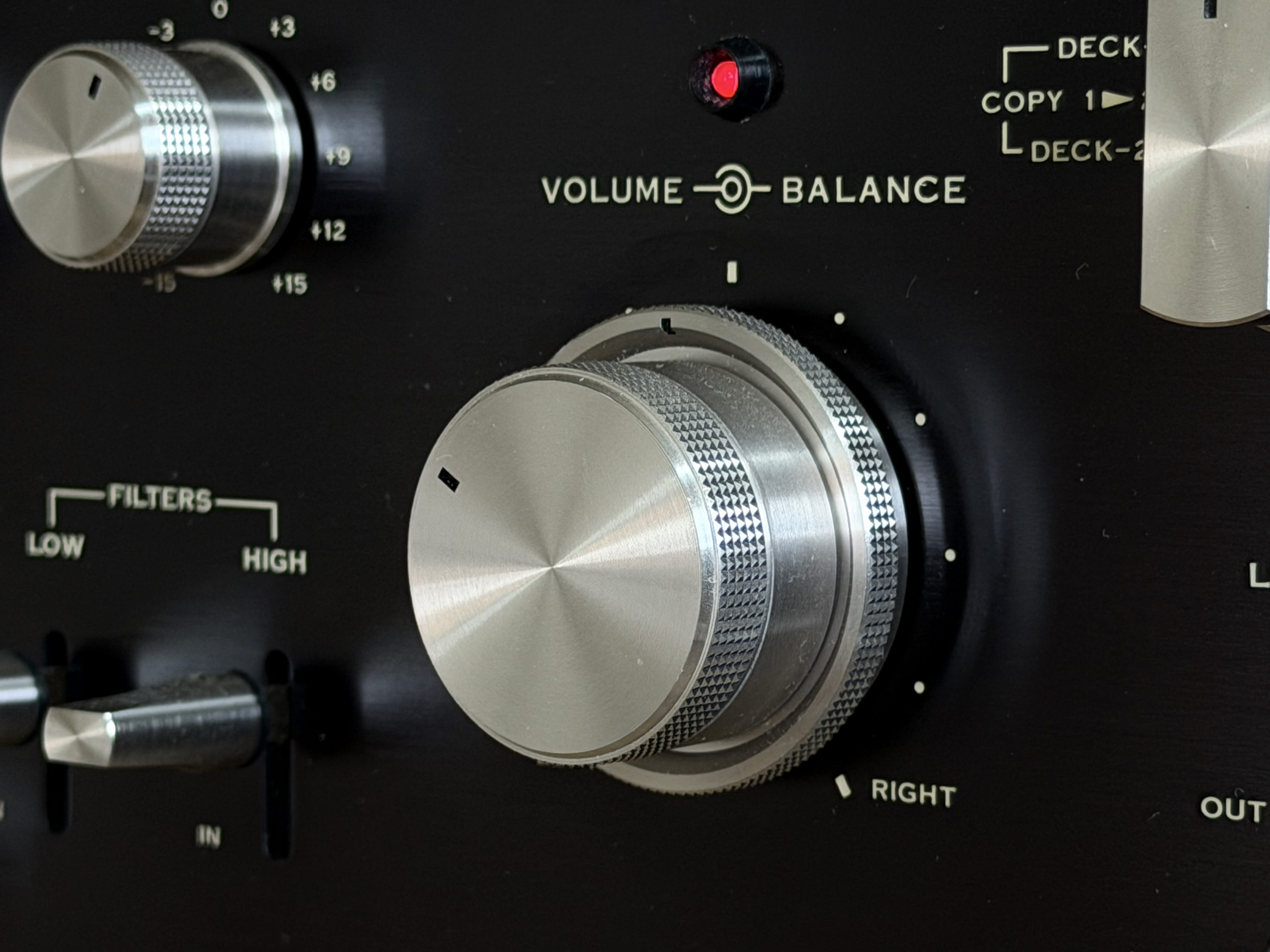
The hand on the volume knob.
Nobody reaches for it on purpose. You’re driving, or cooking, or half-working with something on in the background, and your hand goes up before your brain has had time to file a report on whether that’s allowed. That motion is completely uninterested in whether the song is good, or cool, or defensible at a dinner party. It’s your body voting out loud before your taste gets a chance to overrule it.
You can lie about what you love. The volume knob in your hand cannot.
So like what you like, and blast the thing you’d never post about, because life is genuinely too short and the world currently too full of actual problems to spend any of it curating a self for an audience that isn’t paying attention anyway.
Turn it up. Nobody’s watching.
(Except my daughter, who is always watching, and who will absolutely bring it up later.)
Picked Up
Since I just spent a thousand words defending records I loved twenty-five years ago, here's what's actually been running on my stereo this year. Four of them, four different corners, all worth an afternoon.
Banks, Off With Her Head — Her fifth record, and the one where she went back and got the people who made her first one. Twelve songs, thirty-five minutes, not a wasted second anywhere in it. Sharp, skipping electro-pop with real teeth under the gloss, and Doechii and Sampha both turn up. Longtime readers will appreciate that SOHN, whose Albadas I handed you back in Issue 3, has production credits on here. Listen: Apple · Tidal · Spotify
Laurie Torres, Après coup — Torres is a Montréal musician who spent fifteen years playing in other people's bands before going out to a studio built at the edge of a lake in Québec and making this. Piano, drums, synth and field recordings, improvised in long takes with almost no overdubs. It sits somewhere between experimental jazz and ambient without ever committing to either, and the lo-fi looseness is the whole appeal. Eleven tracks, thirty-two minutes, and it rewards a real listen rather than a background one. My wife just bought it for me on vinyl and it hasn’t left the deck since. Listen: Apple · Tidal · Spotify
ESTA., Francis — ESTA. has been one of the load-bearing producers in the Soulection world for over a decade, and this is finally his own record, named after his first name. He builds beats out of the things nobody else bothers to notice, static off a broken radio at a flea market, wind coming through a gap in a balcony door. Joyce Wrice, Duckwrth, Jayla Darden and Tone Stith all show up across it. Warm, unhurried, and it sounds enormous on a good system. Listen: Apple · Tidal · Spotify
Ibeyi, Offering — The newest thing here, out at the end of June. Twin sisters Lisa-Kaindé and Naomi Díaz built three albums around Lisa’s piano and Naomi’s drums, and on this one they handed both instruments to outside producers and kept only their voices, which are matched so closely you often can't tell where one of them stops. It's their first release on their own label after a decade at XL, and parts of it were made back in Havana, where their father played. Twenty-nine minutes, and it moves. Listen: Apple · Tidal · Spotify
In the Room
Here’s the one thing about taste that keeps me from worrying too much.
You can hand a machine every record ever made and ask it what’s good, and it’ll give you a confident answer. What it can’t tell you is which song makes your particular chest go tight, or why a Nissan Sentra with broken air conditioning was the best listening room you ever had. That part stays stubbornly, uselessly human.
Which is a decent doorway into an episode our studio recently edited and mixed for a longtime client.
Bill Burke runs The Optimism Institute, and his podcast Blue Sky rests on a simple idea, that there’s always blue sky up there and you just have to get above the clouds to see it. In this one he sits down with Dr. Mark Bloomfield, a Cambridge Judge Business School fellow who’s spent over fifteen years applying AI to real business problems. The episode is called “How to Use AI to Become More Human, Not Less,” which is the argument I’ve just spent a whole letter making from the other direction.
Whether you’re a parent trying to navigate this with your kids, a business owner working out what it means for jobs, or just somebody using ChatGPT to build a grocery list, there’s something useful in here and a real dose of optimism underneath it.
Sent Out
Two weeks, one assignment, and this one’s a little uncomfortable.
Play the song out loud.
Not in headphones where nobody can catch you, but on actual speakers, at real volume, with at least one other person somewhere in the house. The one you’d never put on a shared playlist. The one you skip when somebody else is in the car.
Watch what happens in the first four seconds, and what your hand does, and what your face does when somebody looks over at you.
Then hit reply and tell me what it was and what happened. I read every one, and I’m not judging a single one of you, on the grounds that I have already gone first.
Chad
p.s. — I claimed up there that I’ve got no defense for “Hanging by a Moment,” which is still true. What I didn’t mention is that I hadn’t actually heard the thing in twenty years, and I’d made a bet with myself that I could still scream every word of it.
So I went and checked.
Every word came back. No hesitation anywhere in it, no waiting to find out what was coming next, no gap for my brain to catch up through, because my mouth simply had the thing filed somewhere I don’t hold the keys to. Then the drum fill that kicks into the second chorus showed up and my hands started pounding the steering wheel without consulting me about it first, which is this entire letter proving its own point a couple thousand words too late.
And for about ninety seconds I was twenty years old with an electric guitar strapped across my back, fronting a band, playing to a room that knew every line right along with me.
Weirdly cathartic. Genuinely.
I’m also good for another twenty years.